
At a Glance: 5 Styling Principles for a Mora Clock
- 1. Give It Space — A Mora clock commands attention; position it where it has breathing room, not squeezed between furniture. A corner or alcove with clear sightlines works beautifully.
- 2. Let It Lead the Palette — Use the clock's painted colour as your starting point for the room's colour scheme; the soft Swedish folk-art palette pairs naturally with almost every interior style.
- 3. Mix Old and New Confidently — Mora clocks look extraordinary in modern and contemporary interiors; the contrast between antique craftsmanship and clean modern lines is one of the most compelling looks in interior design.
- 4. Consider the Floor — A Mora clock on bare stone, wide-plank oak, or painted floorboards looks far more authentic than one sitting on carpet; if possible, position it on a hard floor surface.
- 5. Light It Well — A picture light above or a floor lamp beside a Mora clock transforms it from furniture into sculpture; evening lighting in particular brings out the depth of the painted case.

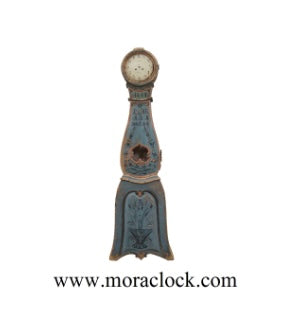
A rare bridal Mora clock — one of the most striking statement pieces in any interior.
Introduction
There is a persistent myth that antique furniture only works in traditional interiors. The Mora clock disproves it entirely. With its sculptural silhouette, folk-art painted surface, and quiet mechanical presence, a genuine Swedish Mora clock is one of the most versatile decorative objects you can introduce to a home — whether that home is a 17th-century farmhouse or a contemporary apartment.
In this guide, we explore how to style a Mora clock in a modern home, covering four of the most popular interior design approaches and the specific considerations that make each one work.
The Gustavian Interior: The Natural Home
The Gustavian style — Sweden's own interpretation of 18th-century French neoclassicism — is the natural spiritual home of the Mora clock. Characterised by pale painted furniture, linen upholstery, restrained ornamentation, and a cool, light-filled palette of greys, whites, and soft blues, the Gustavian interior was the world in which the Mora clock was born.

A grey and white Mora clock is the quintessential Gustavian piece — understated, elegant, and deeply Swedish.
In a Gustavian interior, position your Mora clock against a pale wall — ideally painted in a warm white or soft grey — flanked by a pair of painted chairs or a simple console table. Keep the surrounding furniture low and horizontal to emphasise the clock's height. Accessories should be minimal: a few pieces of Swedish pottery, a linen runner, perhaps a simple mirror above the console. The clock does the talking.
Colour pairings that work particularly well in a Gustavian scheme include grey-painted Mora clocks against warm white walls, cream clocks against pale sage green, and white clocks with gold detailing against a deeper grey-blue.
The Farmhouse Interior: Warmth and Character
The farmhouse interior — whether English, French, or American in character — is one of the most popular interior styles of the past decade, and it is a natural fit for the Mora clock. The warmth, texture, and handmade quality of farmhouse design complement the folk-art character of the clock perfectly.

A white Mora clock with folk-art floral decoration is a perfect farmhouse centrepiece.
In a farmhouse setting, the Mora clock works best in a hallway, kitchen, or living room with exposed beams, stone floors, or wide-plank wooden boards. Position it in a corner or against a chimney breast, and surround it with natural textures — wicker baskets, linen cushions, aged leather, rough-hewn wood. The clock's painted surface and mechanical tick add layers of history and authenticity that no reproduction piece can replicate.
For a farmhouse interior, cream, white, and warm grey Mora clocks work particularly well. A clock with original floral folk-art decoration is especially at home in this setting — the kurbits motifs echo the botanical prints and natural materials that define the farmhouse aesthetic.
The French Country Interior: Romance and Patina
French country style shares much with the farmhouse aesthetic but adds a layer of romantic elegance — soft florals, aged patina, distressed paint, and a palette that leans toward warm creams, dusty roses, and faded blues. The Mora clock, with its centuries of accumulated character, fits this world beautifully.

A cream Mora clock with gold detailing brings a touch of French elegance to any interior.
In a French country interior, pair your Mora clock with a gilded mirror, a marble-topped console, or a painted armoire. Soft lighting — candlelight or warm-toned lamps — brings out the depth of the painted case and creates the kind of atmospheric interior that photographs beautifully. A cream or ivory clock with gold detailing is particularly well suited to this style.
The key to making a Mora clock work in a French country interior is to embrace the patina. Do not try to make the clock look new — the crazing paint, the worn edges, the slightly irregular tick are all part of its charm. This is a piece that has lived, and in a French country interior, that history is the point.
The Minimalist Scandinavian Interior: The Unexpected Star
Perhaps the most surprising — and most striking — way to style a Mora clock is in a minimalist Scandinavian interior. The clean lines, pale palette, and deliberate restraint of contemporary Nordic design create a perfect foil for the sculptural complexity of an antique Mora clock.

A white Mora clock with gold detailing stands as a sculptural statement in a minimalist Scandinavian interior.
In a minimalist setting, the Mora clock should be the only antique in the room — or at least the dominant one. Surround it with contemporary furniture in natural materials: pale oak, linen, concrete, or matte white. Keep the walls bare or hung with a single large artwork. The contrast between the clock's folk-art complexity and the room's deliberate simplicity creates a tension that is genuinely compelling.
For a minimalist Scandinavian interior, choose a Mora clock in white, pale grey, or cream — colours that harmonise with the Nordic palette while still standing out as a statement piece. A clock with restrained decoration works better here than one with elaborate floral motifs.
Practical Styling Tips

Whatever your interior style, a Mora clock rewards thoughtful placement and good lighting.
Whichever interior style you are working with, a few practical principles apply universally. Position the clock on a hard, level floor surface — stone, tile, or wood — rather than carpet, which can make it look less grounded and makes levelling more difficult. Ensure the wall behind the clock is sound and dry, as damp can damage both the case and the movement over time.
Consider the acoustic as well as the visual impact of your clock. The gentle tick of a pendulum movement and the hourly strike of the bell are part of the experience — position the clock where these sounds can be appreciated rather than muffled. In an open-plan space, the tick of a Mora clock adds a layer of warmth and life that no other object can provide.
Browse our current collection of antique Mora clocks to find the piece that is right for your home — and get in touch if you would like advice on which clock would work best in your specific interior.
Mora Clock — specialists in authentic antique Swedish Mora clocks for every interior style.