FAQ
Where can I buy a Mora Clock in the USA?
MoraClock.com is one of the leading specialist suppliers of antique Swedish Mora clocks to the USA. We ship directly from our London warehouse with full insurance and specialist antique packaging.
Where did Mora Clocks come from?
Mora Clocks originally came from the Darlarna Province of Sweden in the late 17th and early 18th Century. They are believed to have been originally made in the town of Mora (which gave its name to this style of clock). Regional variations in Mora Clocks exist depending upon location. For example Mora Clocks from the North of Sweden tend to be very tall whilst those from the South are slightly more ornately carved.
Are Mora Clocks an investment?
Mora clocks are becoming increasingly rare and were made for only about 50 years and sold by 'journey men' who travelled around Sweden selling them. The mechanisms of most more clocks were fairly basic. When cheaper more reliable clocks were imported into Sweden (principally German clocks) this cottage industry died out. They are principally bought for their style and uniqueness. More specialist Mora Clocks that have been made by a super clocksmith (generally Stockholm based) and ornately decorated are very rare and should appreciate in value as genuine antiques.
What is the difference between a male and female Mora clock?
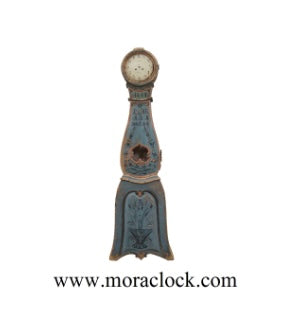
Mora clocks come in two distinct body shapes, traditionally referred to as "male" and "female." The female Mora clock has a gracefully curved, waisted body — wider at the top and bottom with a narrower middle — giving it an elegant, hourglass silhouette. The male Mora clock has a straighter, more upright case with less curvature. Both styles are authentic and highly sought after; the choice between them is largely one of personal taste and how the clock will sit within your interior space.
How are authentic Mora clocks decorated?
Genuine antique Mora clocks were hand-painted by skilled craftspeople, typically in soft Gustavian colours such as pale grey, duck-egg blue, sage green, and cream. Decorative motifs often include floral sprays, garlands, and delicate painted panels. Some clocks — particularly those made by Stockholm-based master clockmakers — feature more elaborate carving and ornamentation and are considerably rarer. Original paintwork, even when faded or worn, is considered far more desirable than a restored or repainted finish, as it retains authenticity and historical character.
Do Mora clocks still work and keep accurate time?
Yes. All Mora clocks sold by MoraClock.com come with fully working longcase clock mechanisms. Most original Mora clocks were fitted with a basic 8-day movement, meaning they need winding once a week. Where an original mechanism is beyond repair, we fit a reliable modern replacement movement, which is clearly stated in the product listing. With occasional regulation, a Mora clock will keep good time as a functioning timepiece as well as a beautiful antique.
How are Mora clocks shipped to the USA and will mine arrive safely?
We have extensive experience shipping Mora clocks internationally and take great care to ensure safe arrival. Each clock is professionally crated, with the clock mechanism, weights, and pendulum removed and packed separately to prevent any movement damage in transit. We use trusted specialist carriers experienced in antique furniture, and full insurance is included. Buyers in the USA receive full tracking information and are guided through reassembly on arrival, which is straightforward and requires no specialist tools.
How tall is a typical Mora clock and will it fit in my home?
Mora clocks vary in height, but most stand between 190cm and 220cm (approximately 6'3" to 7'3"). Clocks from northern Sweden tend to be at the taller end of this range, while those from southern regions are often slightly shorter and more ornately decorated. Each listing on our site includes precise dimensions so you can check ceiling height and floor space before purchasing. We're also happy to advise on suitability for your space — just get in touch via our contact page.
What should I look for to make sure a Mora clock is genuinely antique?
Authentic antique Mora clocks date from roughly the mid-18th to early 19th century and show natural signs of age throughout — in the wood, the paint, the mechanism, and the clock face. Key things to look for include hand-painted decoration (rather than printed or stencilled designs), a solid birchwood case, an original or period-correct longcase movement, and a painted or enamelled clock face that may bear the initials or name of the clockmaker. Beware of reproduction Mora-style clocks that copy the shape but lack genuine age. All clocks listed on MoraClock.com are verified antiques, personally sourced from Sweden.