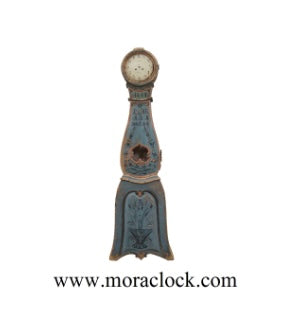


An original antique Swedish Mora clock — note the characteristic waisted silhouette and hand-painted case.
At a Glance: 6 Key Authenticity Checks
- 1. Case Shape — A genuine Mora clock has a distinctive hourglass-waisted body with a rounded bonnet top; modern reproductions often get the proportions wrong.
- 2. Original Paint — Look for layered, crackled paintwork with visible wear at natural touch points; a freshly repainted clock may be hiding a troubled history.
- 3. Movement Type — Authentic antique Mora clocks house a hand-forged iron or brass weight-driven pendulum movement, not a modern quartz or battery mechanism.
- 4. Dial Markings — Original faces feature hand-painted Roman numerals, often with a maker's name or parish inscription, on a tin or paper dial with age-appropriate foxing.
- 5. Wood Type — Genuine Swedish Mora clocks are constructed from locally sourced birch, which has a fine, pale grain quite different from the pine or MDF used in reproductions.
- 6. Proportions — A true antique stands between 195 cm and 220 cm tall; anything significantly shorter or taller should raise questions.
Introduction
The Mora clock is one of Scandinavia's most enduring and beloved pieces of decorative folk art. Produced in the Mora region of Dalarna, Sweden, from the mid-eighteenth century onwards, these tall-case clocks were the pride of Swedish farmhouses and manor homes alike. Today, a genuine antique Mora clock is a serious collector's piece — and, inevitably, the market has attracted its share of reproductions, heavily restored examples, and outright fakes.
At Mora Clock, we have spent years sourcing, restoring, and living with these extraordinary objects. We know what separates a true antique from a convincing imitation, and in this guide we share everything you need to know before you buy.
1. The Case Shape: The Mora Clock's Unmistakable Silhouette
The single most recognisable feature of an authentic Mora clock is its case shape. The body narrows dramatically at the waist — creating that famous hourglass profile — before swelling again into a generous trunk and rising to a rounded, often hood-shaped bonnet. This silhouette was not merely decorative; it was a structural solution developed by Mora craftsmen to make the clock stable on uneven stone or wooden floors.

The hourglass waist is the hallmark of a genuine Swedish Mora clock.
Reproductions frequently miss the subtlety of this shape. The waist may be too shallow, the bonnet too angular, or the overall proportions too squat. When viewing a clock in person, step back and look at the whole form. A genuine piece has an almost organic elegance — it looks as though it grew into its shape rather than being assembled from components.
2. Original Paint vs. Repaint: Reading the Surface
Swedish Mora clocks were traditionally painted in soft, chalky palettes — creams, pale blues, sage greens, and warm whites — often decorated with folk-art floral motifs called kurbits. The paint was applied in multiple thin layers over many decades, and on a genuine antique you will see the evidence of this history.

Original folk-art floral decoration on an authentic Mora clock case.
Look for fine crazing or crackle across the surface — this is the natural result of paint contracting and expanding over 150 to 250 years. Pay close attention to the edges of mouldings, the feet, and the area around the door hinges: these are the spots where genuine wear accumulates through normal use. If the wear looks uniform or artificially distressed, be cautious.
A repainted clock is not necessarily a bad thing — many antique Mora clocks have been refreshed over the centuries — but a recent repaint can conceal cracks, repairs, or replaced panels. Always ask the seller whether the paint is original, and if possible, examine the interior of the case where paint is rarely touched up.

A cream-painted example showing the layered, chalky finish typical of genuine period paintwork.
3. The Movement: What's Ticking Inside?
The heart of any genuine Swedish Mora clock is its movement, and this is where fakes are most easily exposed. Authentic antique Mora clocks were fitted with weight-driven, pendulum-regulated movements — typically 30-hour or 8-day — hand-forged from iron or brass by local clockmakers in the Dalarna region.

A period-correct weight-driven longcase movement of the type found in authentic Mora clocks.
When you open the hood and inspect the movement, you should see the characteristic plates, pillars, and hand-cut gear teeth of a pre-industrial mechanism. The finish will be uneven, the surfaces showing file marks and hand-finishing. If you find a quartz movement, a battery compartment, or a modern stamped-metal mechanism, the clock has been converted — or was never a genuine antique in the first place.
Also check the pendulum and weights. Original weights are typically cast iron or lead, and the pendulum rod will show patina consistent with its age. Bright, shiny components in an otherwise aged clock are a red flag.
4. The Dial: Handmade Marks of Authenticity
The clock face is one of the richest sources of authenticity information. On a genuine antique Mora clock, the dial will almost always be hand-painted, typically on a tin or paper ground, with Roman numerals rendered in a slightly irregular, human hand. Look for the characteristic sweep of the numerals — no two are perfectly identical on an original dial.

Hand-painted gold detailing on an original Mora clock dial — note the subtle irregularities that confirm hand craftsmanship.
Many original dials carry a maker's inscription — sometimes the clockmaker's name, sometimes the name of the parish or town. This is a strong indicator of authenticity and can often be cross-referenced with historical records. Age-related foxing (small brown spots), yellowing, and minor flaking are all positive signs on a dial; a pristine, perfectly printed face almost certainly indicates a reproduction or replacement.
The hands themselves should be hand-cut from steel or brass, with a blued or darkened finish. Perfectly symmetrical, machine-cut hands are a modern addition.
5. The Wood: Birch Tells the Story
Authentic Mora clocks were built from birch — the most abundant hardwood in the Dalarna region of Sweden. Birch has a distinctive fine, pale grain with occasional small knots, and it ages to a warm honey tone beneath the paint. If you can examine any unpainted interior surfaces — the back panel, the interior of the trunk, or the underside of the base — you should see this characteristic grain.

Interior and case detail revealing the fine birch grain characteristic of authentic Swedish construction.
Reproductions are frequently made from pine, which has a coarser, more resinous grain, or from MDF and composite materials, which have no grain at all. A simple visual inspection of any exposed wood — or a gentle touch to feel the density and texture — can tell you a great deal. Birch is notably harder and heavier than pine, and a genuine antique Mora clock will feel substantial and solid.
6. Proportions: Size Matters
A genuine antique Mora clock is a tall piece of furniture. Most examples stand between 195 cm and 220 cm in height, with a trunk width of approximately 40–50 cm at its widest point. The proportions are carefully balanced: the hood, trunk, and base each occupy a specific visual weight that gives the clock its stately presence.

A full-height authentic Mora clock demonstrating the correct proportions — hood, waist, trunk, and base in perfect balance.
Be wary of clocks that are significantly shorter than this range. Some reproductions are scaled down to suit modern ceiling heights, and the result is a piece that simply does not carry the same visual authority. Equally, a clock that is unusually wide or narrow may have had panels replaced or the case altered at some point in its history.
Buying with Confidence
Identifying an authentic Mora clock takes experience, but the six checks above give you a solid framework for any viewing. At Mora Clock, every piece in our collection has been personally sourced and assessed against these criteria. We provide full provenance information where available, and we are always happy to answer detailed questions about any clock's history, movement, and condition.

A rare bridal Mora clock from our collection — one of the most sought-after variants among serious collectors.
Whether you are a first-time buyer or an experienced collector, we believe that knowledge is the best protection against disappointment. Browse our current collection of verified antique Mora clocks, and feel free to get in touch — we are here to help you find the right piece with complete confidence.
Mora Clock — specialists in authentic antique Swedish Mora clocks, sourced, verified, and delivered to collectors worldwide.