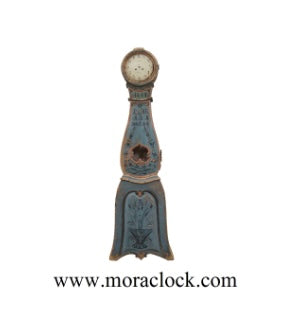

Few objects capture the spirit of Swedish folk culture as completely as the Mora clock. Tall, graceful, and hand-decorated with the distinctive motifs of Dalarna's rural craftsmen, these longcase clocks have been treasured in Scandinavian homes for over two centuries. Today they are collected and admired around the world. But where did they come from, and how did a small town in central Sweden become synonymous with one of the most recognisable clock styles in history?
The Origins of Clockmaking in Mora
The story of the Mora clock begins in the mid-18th century in the parish of Mora, situated on the western shore of Lake Siljan in Dalarna County, Sweden. The region had a long tradition of skilled craftsmanship, and when clockmaking technology began to spread across Europe, local artisans were quick to adopt it. According to Wikipedia, the first Mora clocks were produced around the 1740s, with the industry growing rapidly through the latter half of the 18th century.
The clockmaking trade in Mora was organised as a cottage industry, with different families and workshops specialising in different components. Some made the wooden cases, others the mechanical movements, and others the painted dials. These parts were then assembled and sold by travelling merchants who carried the clocks across Sweden on sledges during the winter months, when the frozen lakes and rivers made transport easier.
The Golden Age: 1780–1850
The late 18th and early 19th centuries represented the golden age of Mora clock production. During this period, the distinctive hourglass silhouette that defines the style became standardised, and the quality of both the movements and the decorative painting reached its peak. Clockmakers began signing their work, and regional variations in style emerged — clocks from Hälsingland, for example, often featured more elaborate folk art painting than those from the Mora district itself.
The Rococo style, fashionable across Europe during the mid-18th century, had a significant influence on early Mora clock design. Carved crowns, scrolled hoods, and ornate painted borders all reflect the decorative vocabulary of the period. As the 19th century progressed, the Gustavian style — Sweden's interpretation of Neoclassicism, characterised by restrained elegance, pale colours, and classical motifs — became increasingly influential. Many Mora clocks from this era feature the cream and grey painted finishes with gold detailing that are now so closely associated with the Gustavian aesthetic. The Gustavian style takes its name from King Gustav III of Sweden, who reigned from 1771 to 1792 and was a great patron of the arts.
Folk Art and Regional Identity
One of the most remarkable aspects of Mora clock history is the way in which the clocks served as a canvas for Swedish folk art. The painted decoration on a Mora clock was not merely ornamental — it was an expression of regional identity, personal taste, and social status. Floral motifs, scrolling vines, and stylised birds were common across all regions, but the specific palette and style of painting could identify a clock's origin with considerable precision.
Some of the most prized Mora clocks are those made to mark special occasions. The Bridal Mora Clock — known in Swedish as the Ångermanlandsbrud — is perhaps the most extraordinary example. These rare clocks were made to resemble a bride's dress, with the body of the case carved and painted to suggest the folds and details of a wedding gown. They were typically commissioned as wedding gifts and represent the pinnacle of the clockmaker's and painter's art.
Decline and Rediscovery
By the latter half of the 19th century, industrialisation had begun to undermine the cottage industry model that had sustained Mora clockmaking for over a century. Factory-produced clocks from Germany and elsewhere were cheaper and more uniform, and demand for hand-crafted longcase clocks declined. Production in Mora slowed significantly, and by the early 20th century the great age of Mora clockmaking was effectively over.
However, the clocks themselves endured. Passed down through Swedish families, sold at rural auctions, and gradually recognised by antique dealers and collectors, Mora clocks began to attract serious attention from the mid-20th century onwards. The growing international interest in Scandinavian design — driven in part by the global success of Swedish furniture and interiors — brought Mora clocks to the attention of collectors in the United States, the United Kingdom, and beyond. Auction houses and specialist dealers began to document and study the clocks more systematically, and prices rose accordingly. The British Antique Dealers' Association (BADA) and equivalent bodies in other countries helped establish standards for the authentication and valuation of Scandinavian antiques during this period.
Mora Clocks Today
Today, authentic antique Mora clocks are genuinely rare. The finest examples — particularly signed pieces, Bridal clocks, and those with exceptional original paintwork — command significant prices at auction and through specialist dealers. Collectors prize them not only for their beauty but for their historical significance as documents of Swedish rural life and craftsmanship.

The enduring appeal of the Mora clock lies in its combination of qualities that are rarely found together: functional precision, artistic beauty, historical depth, and a distinctive national character. Whether displayed in a traditional Scandinavian interior or used as a statement piece in a contemporary home, a Mora clock brings with it centuries of history and the unmistakable spirit of Dalarna. All of the clocks in our collection are available for shipping to the USA and worldwide, making it possible for collectors and enthusiasts everywhere to own a piece of this remarkable heritage.