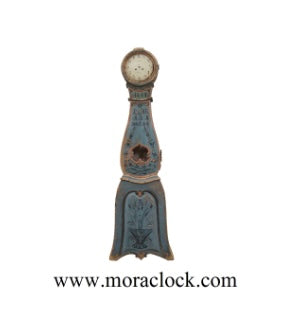

Mora clocks are among the most distinctive and sought-after pieces of Scandinavian antique furniture. Produced in the Mora region of Dalarna, Sweden, from the mid-18th century onwards, these tall longcase clocks have captivated collectors and interior designers around the world. But with their growing popularity has come an increase in reproductions and misattributed pieces. So how do you tell a genuine antique Mora clock from a later copy? Here is what to look for.
1. Understand What a Mora Clock Is
A Mora clock is a type of Swedish longcase clock — sometimes called a grandfather clock — made in and around the town of Mora in Dalarna County, Sweden. Clockmaking became a cottage industry in the region during the late 1700s, with local craftsmen producing both the wooden cases and the mechanical movements. The clocks were then sold across Sweden and exported throughout Europe. According to Wikipedia, production peaked in the 19th century, with thousands of clocks made each year.
2. Look at the Case Shape
One of the most recognisable features of a Mora clock is its distinctive hourglass or waisted silhouette. Unlike the more rigid, boxy form of English or German longcase clocks, the Mora clock has a gently curved body that narrows at the waist and flares again at the base. The hood — the top section housing the clock face — is typically rounded or bonnet-shaped, often with a carved crown or finial. This organic, almost sculptural form is a hallmark of the style and is very difficult to replicate convincingly in a modern reproduction.
3. Examine the Painted Decoration
Authentic antique Mora clocks are almost always hand-painted, and the decoration tells you a great deal about the clock's age and origin. Common motifs include floral folk art patterns, scrolling vines, and decorative borders, typically painted in red, green, blue, and gold against a cream, white, or grey ground. The painting on a genuine antique will show signs of age: slight cracking, fading, and wear consistent with the clock's years of use. Be wary of decoration that looks too crisp or uniform — this can indicate a later repaint or a reproduction. Some clocks, particularly those from Hälsingland, feature more elaborate pictorial scenes or regional folk art motifs that are highly specific to their area of origin.
4. Check the Clockmaker's Signature
Many authentic Mora clocks bear the signature or initials of the clockmaker on the dial face. These inscriptions often include the maker's name and the town — for example, "And Erson / Mora" or initials such as "AAL, Mora" or "E. Bergquist." Cross-referencing these names with historical records of Swedish clockmakers can help confirm authenticity. The Encyclopaedia Britannica provides useful background on the history of clockmaking traditions that can help contextualise regional makers.
5. Inspect the Movement
The mechanical movement inside a Mora clock is one of the most reliable indicators of authenticity. Genuine antique movements are weight-driven, typically using two iron weights suspended on chains or ropes, with a swinging pendulum to regulate timekeeping. The movement will often include a bell chime that strikes on the hour — and sometimes a single chime on the half hour. Look for hand-cut gears, hand-filed components, and the general irregularity that comes with hand craftsmanship. Machine-made movements with perfectly uniform parts are a sign of a later or non-original mechanism. It is also worth noting that not all antique Mora clocks will be in working order — age, lack of servicing, and missing parts are all common — so a non-functioning movement does not necessarily indicate a fake.
6. Assess the Wood and Construction
Mora clock cases were traditionally made from local softwoods, most commonly pine. The joinery on an authentic antique will be hand-cut, with wooden pegs or hand-forged iron nails rather than modern screws. Look at the back of the case and the interior surfaces — genuine antiques will show tool marks, uneven surfaces, and the natural patina of aged wood. The paint on the interior is often rough or unfinished, as it was never intended to be seen. If the wood looks machine-planed and the joints are perfectly uniform, treat this as a red flag.
7. Consider the Proportions and Height
Authentic Mora clocks typically stand between 180cm and 250cm tall, though there is natural variation. The proportions of the hood, waist, and base should feel balanced and harmonious. Reproductions sometimes get the proportions slightly wrong — the hood may be too large or the waist too short — giving the clock an awkward appearance when compared to a genuine example.
8. Seek Specialist Advice
If you are considering a significant purchase, it is always worth consulting a specialist dealer or auction house with experience in Scandinavian antiques. Organisations such as the British Antique Dealers' Association (BADA) can help you find reputable dealers who can provide provenance information and authentication guidance. Auction records from major houses can also provide useful comparisons for style, condition, and pricing.
Final Thoughts
Identifying an authentic Mora clock takes a combination of knowledge, careful observation, and — ideally — hands-on experience with genuine examples. The key markers are the distinctive waisted case shape, hand-painted folk art decoration showing genuine age, a weight-driven pendulum movement, hand-crafted wooden construction, and ideally a clockmaker's signature on the dial. With these criteria in mind, you will be well equipped to distinguish a true antique Swedish Mora clock from a later imitation — and to appreciate the extraordinary craftsmanship that has made these clocks so enduringly beloved.